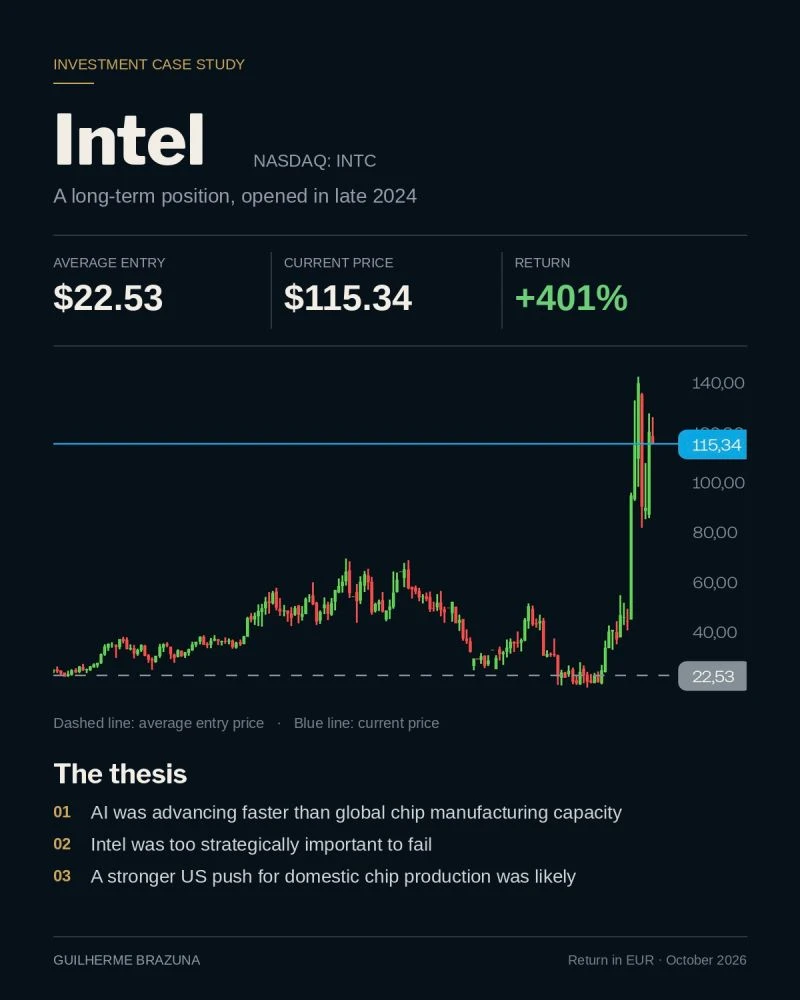
I have always been passionate about investing. I have gained and I have lost, but what really counts are the lessons. Here is one of them. In late 2024, Intel was one of the most disliked stocks in the market. It was losing ground to AMD and TSMC, spending heavily on new fabs, and its share price had collapsed. I opened a long-term position anyway, ahead of the US election. My thesis rested on three points: 1. AI was advancing faster than global chip manufacturing capacity. 2. Intel was too strategically important to fail, as the only American company capable of leading-edge chip manufacturing at scale. 3. A stronger US push for domestic chip production was likely. Much of that played out. In 2025, the US government took a stake of around 10% in Intel, followed by investments from Nvidia and SoftBank. But the biggest driver was something I underestimated: AI demand shifting back towards CPUs, turning Intel's data centre business into a growth story. What I took from it: - When the market agrees a company is finished, the price often already reflects the worst case. - Being right about a thesis is not the same as being right about why a stock moves. - Position sizing matters. This was a small position, which limited my gain as much as my risk. The question now is not "Was I right?" but "Would I buy it today at this price?" I am currently completing a Master's in Finance at Hult International Business School, and decisions like this are why I want to build a career in investments. Not investment advice. Visual designed with AI, based on my actual portfolio data.